
Get Quick With an Agility Progression Sequence, Part 1
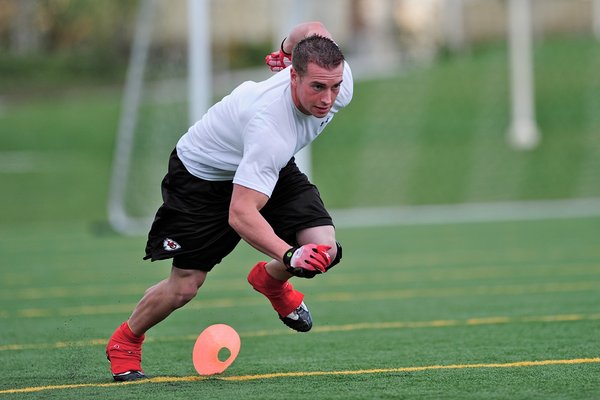 Athletes are always working to improve agility and quickness. Many coaches and trainers believe drills, or a combination of repetitive movements, will help their athletes gain an advantage against the competition.
Gaining agility and quickness for game-time situations involves many components. True agility isn’t just moving at different speeds in different directions; it’s moving in all directions with great speed in response to a stimulus.
Just as strength training follows a progression, agility and quickness training should also progress: from simple change-of-direction drills—closed [or set pattern] drills that use anticipation and pattern recognition, such as the Pro Agility Run—to advanced, open [cue-based or reactive] drills that combine complex movements with reactive elements, forcing you to respond to verbal or visual cues . . . just like in most sports.
Follow the guidelines, progressions and exercises below to take your agility program to new heights.
Level 1 – Basic Agility
This level uses set patterns of cones or lines as markers. Focus on technique, body position, basic cuts and movements.
90-Degree Hard Cut Cone Drill
- Set three cones five yards apart in an “L” pattern
- Starting at the top of the “L,” run five yards to cone B, plant outside leg and make a sharp left cut to cone C, at a 90-degree angle from cone B
- Set up cones to create a backwards “L”; perform drill, cutting to the right at cone C
- 3×5 each way
Up and Back Plant [Variation of Backpedal Progression Drill]
- Set two cones 10 yards apart
- Sprint from cone A to Cone B
- At cone B, sink hips, keeping weight over toes; plant and backpedal back to cone A
- 3×5
Coaching Point: Work on planting off both right and left legs
180-Degree Run and Turn
- Set out two cones, 10 to 15 yards apart
- Sprint from cone A to cone B
- At cone B, stop, plant and pivot 180 degrees
- Facing cone A, sprint toward it
- At cone A, stop, plant and pivot 180 degrees
- Repeat sequence
- 3×3; aim for runs under 10 seconds
Coaching Point: Work to pivot off of both left and right legs
360-Degree Run and Turn
- Set out four to six cones 10 yards apart
- Sprint from cone A to cone B
- At cone B, slow down, drop hips, plant and pivot 360 degrees to face cone C
- Sprint to cone C and repeat, doing a 360-degree turn
- 3×5
Coaching Point: Do right and left turns
Check back later this week for Part 2 of this Agility Progression Sequence.
RECOMMENDED FOR YOU
MOST POPULAR




Get Quick With an Agility Progression Sequence, Part 1
Athletes are always working to improve agility and quickness. Many coaches and trainers believe drills, or a combination of repetitive movements, will help their athletes gain an advantage against the competition.
Gaining agility and quickness for game-time situations involves many components. True agility isn’t just moving at different speeds in different directions; it’s moving in all directions with great speed in response to a stimulus.
Just as strength training follows a progression, agility and quickness training should also progress: from simple change-of-direction drills—closed [or set pattern] drills that use anticipation and pattern recognition, such as the Pro Agility Run—to advanced, open [cue-based or reactive] drills that combine complex movements with reactive elements, forcing you to respond to verbal or visual cues . . . just like in most sports.
Follow the guidelines, progressions and exercises below to take your agility program to new heights.
Level 1 – Basic Agility
This level uses set patterns of cones or lines as markers. Focus on technique, body position, basic cuts and movements.
90-Degree Hard Cut Cone Drill
- Set three cones five yards apart in an “L” pattern
- Starting at the top of the “L,” run five yards to cone B, plant outside leg and make a sharp left cut to cone C, at a 90-degree angle from cone B
- Set up cones to create a backwards “L”; perform drill, cutting to the right at cone C
- 3×5 each way
Up and Back Plant [Variation of Backpedal Progression Drill]
- Set two cones 10 yards apart
- Sprint from cone A to Cone B
- At cone B, sink hips, keeping weight over toes; plant and backpedal back to cone A
- 3×5
Coaching Point: Work on planting off both right and left legs
180-Degree Run and Turn
- Set out two cones, 10 to 15 yards apart
- Sprint from cone A to cone B
- At cone B, stop, plant and pivot 180 degrees
- Facing cone A, sprint toward it
- At cone A, stop, plant and pivot 180 degrees
- Repeat sequence
- 3×3; aim for runs under 10 seconds
Coaching Point: Work to pivot off of both left and right legs
360-Degree Run and Turn
- Set out four to six cones 10 yards apart
- Sprint from cone A to cone B
- At cone B, slow down, drop hips, plant and pivot 360 degrees to face cone C
- Sprint to cone C and repeat, doing a 360-degree turn
- 3×5
Coaching Point: Do right and left turns
Check back later this week for Part 2 of this Agility Progression Sequence.