
How Basketball Players Can Conquer Knee Pain

General pain in the front of the knee [called patellar tendonopathy] has become so closely associated with basketball that many athletes and coaches accept it as a normal consequence of training and playing. However, simple stretches and strengthening exercises, which athletes can add to their training programs, can alleviate or eliminate this pain permanently.
Joint mobility and stability simply can’t be emphasized enough. I consistently find many basketball players who lack enough mobility in their ankle joints and strength in their hip joints to run and jump efficiently.
Before you attempt to crossover your opponent on the court, try this simple ankle exercise to increase mobility, which will allow you to move more freely, prevent injury and take pressure off your knees. Remember, if you don’t have the appropriate motion at one joint, your body will be forced to compensate elsewhere—and unfortunately for your knees, they’re the joints directly above your ankles.
Ankle Mobilization
- Place the front half of your foot on a slant board or a slightly elevated surface
- Keeping your heel on the floor, drive your knee forward, pointing it toward your big toe
- Hold for three seconds and repeat, this time moving toward your second toe
- Repeat and drive toward your third toe
- Repeat sequence five times for a total of 15 knee drives
- Repeat with other leg
The stretch should be felt toward the base of your ankle and throughout your Achilles tendon. Avoid driving your knee inward.

Static Calf Stretch
The muscles that support and control the joint must be in good health and able to withstand the tremendous stress placed on them during repetitive jumping activities, like rebounding.
- Place the front half of your foot on an elevated surface or slant board and lock out your knee; make sure the knee is straight and in line with your ankle and hip
- Lean forward at the hip until you feel a stretch in the back of your calf muscle
- Hold for 30 seconds
- 1×6 per leg
For a more advanced stretch, place a folded towel under your arch so the motion comes from the actual ankle joint and not through the many small foot joints.

Quadriceps [Rectus Femoris] Flexibility
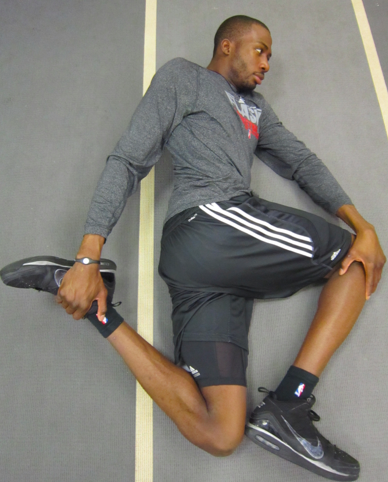
The Quad Stretch is one of the most overlooked and poorly-taught stretches of all time. Because the rectus femoris crosses two joints [hip and knee], athletes must extend the hip and flex the knee to ensure a quality stretch. In addition, the Brettzel Stretch is a great exercise for lengthening the quads and alleviating muscle tension.
- Lie on your left side and hug your right lower leg with your left hand
- Pull your left heel toward your butt with the opposite hand
- Perform on opposite side
Note: this may be difficult to perform by yourself.
Hip Flexor [Psoas and Iliacus] Flexibility
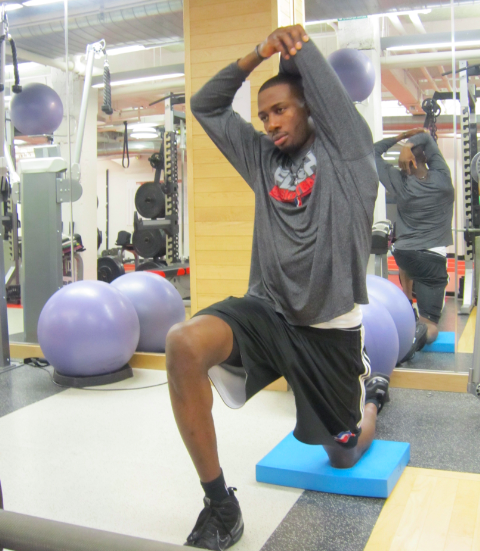
In the same way that the ankle requires mobility and flexibility, the hip flexor [psoas and iliacus] also requires this freedom. Tightness in the hips often rears its ugly head as knee and back pain—troublesome for the basketball athlete.
- Place your left knee on a pad or pillow and your right foot in front of you so that each knee forms a 90-degree angle
- Lean back slightly
- With your left arm, reach up and over the top of your head while actively squeezing your left glute muscle
- To increase the stretch to your hip flexor, grab your left elbow with your right hand and pull
- Hold stretch for 20 to 30 seconds; repeat two to three times
- Switch sides and repeat
Hip Mobility
Regardless of the hip’s role in knee pain, you need great hip mobility and strength to play basketball. Below are a couple of exercises to develop these attributes.
Clam Shells
We have all done this exercise, but I challenge you to do it right—that’s the only way you’ll get the most out of it.
Coaching Points: Rotate the top hip slightly forward and down to place the posterior fibers of the gluteus medius into an anti-gravity position. Many beginners have trouble disassociating their hip motion from their lumbar spine [the lower part of the back]. Try placing your lumbar spine flat against the wall during the hip rotation to see this movement. Increase resistance with bands, cuff weights or manual resistance.

Reverse Clam Shells
This exercise may not need resistance at first. In fact, many tall guys with knee pain cannot fully perform this motion. If you are unable to perform it alone, assistance from a coach or teammate will do the trick. Once you can perform the exercise alone, add a band or cuff weights for extra resistance.
Coaching Point: Squeeze a small ball or towel between your knees while performing the exercise.

Bent Knee Bridges
This equipment-free exercise integrates core work from the traditional Side Bridge while isolating the gluteus medius.
- Supporting your body with your forearm directly under your shoulder, lie on your side with knees bent at a 90-degree angle
- Lower hips to ground, flex glutes and contract core muscles to rise into a side bridge position
- Start with five reps of five seconds and increase reps as you progress
Coaching Points: Keep the top leg elevated. Although the bottom leg is the target, additional hip abduction adds difficulty to the exercise. Incorporate all cues from traditional Side Bridge position as well.

Eccentric Training
One technique that has stood the test of time and continues to be supported by a mountain of evidence in the fight against knee pain is eccentric strengthening, which is working the muscles while they are being lengthened.
The primary challenge of performing an eccentric program with knee pain is that it will be slightly uncomfortable for a period of time. Therefore, compliance is of the utmost importance. Once the exercise becomes comfortable, increase your load by adding a weight vest.
I recommend performing the Eccentric Single-Leg Lowering exercise for three sets of 15 repetitions twice daily, seven days a week.
Needless to say, this program takes planning and diligence, but if you’re currently experiencing knee pain, be assured the outcome is definitely worth the work.
- Stand on a slant board or decline and slowly lower down with the target leg
- Once at the bottom position, place opposite foot on the board and stand back up with two feet

Photos: highschoolsports.al.com; courtesy of Art Horne
Art Horne is director of sports performance at Northeastern University, where he also serves as athletic trainer and strength coach for the men’s basketball team. Horne came to NU in July 2000, after graduating with a master’s degree in Education from Boston University. He received his bachelor’s degree in athletic training and physical education from Canisius College. In addition to his work with collegiate teams, Horne continues to train former Northeastern basketball players as they continue their careers on the professional stage.
RECOMMENDED FOR YOU


MOST POPULAR

How Basketball Players Can Conquer Knee Pain
General pain in the front of the knee [called patellar tendonopathy] has become so closely associated with basketball that many athletes and coaches accept it as a normal consequence of training and playing. However, simple stretches and strengthening exercises, which athletes can add to their training programs, can alleviate or eliminate this pain permanently.
Joint mobility and stability simply can’t be emphasized enough. I consistently find many basketball players who lack enough mobility in their ankle joints and strength in their hip joints to run and jump efficiently.
Before you attempt to crossover your opponent on the court, try this simple ankle exercise to increase mobility, which will allow you to move more freely, prevent injury and take pressure off your knees. Remember, if you don’t have the appropriate motion at one joint, your body will be forced to compensate elsewhere—and unfortunately for your knees, they’re the joints directly above your ankles.
Ankle Mobilization
- Place the front half of your foot on a slant board or a slightly elevated surface
- Keeping your heel on the floor, drive your knee forward, pointing it toward your big toe
- Hold for three seconds and repeat, this time moving toward your second toe
- Repeat and drive toward your third toe
- Repeat sequence five times for a total of 15 knee drives
- Repeat with other leg
The stretch should be felt toward the base of your ankle and throughout your Achilles tendon. Avoid driving your knee inward.
Static Calf Stretch
The muscles that support and control the joint must be in good health and able to withstand the tremendous stress placed on them during repetitive jumping activities, like rebounding.
- Place the front half of your foot on an elevated surface or slant board and lock out your knee; make sure the knee is straight and in line with your ankle and hip
- Lean forward at the hip until you feel a stretch in the back of your calf muscle
- Hold for 30 seconds
- 1×6 per leg
For a more advanced stretch, place a folded towel under your arch so the motion comes from the actual ankle joint and not through the many small foot joints.
Quadriceps [Rectus Femoris] Flexibility
The Quad Stretch is one of the most overlooked and poorly-taught stretches of all time. Because the rectus femoris crosses two joints [hip and knee], athletes must extend the hip and flex the knee to ensure a quality stretch. In addition, the Brettzel Stretch is a great exercise for lengthening the quads and alleviating muscle tension.
- Lie on your left side and hug your right lower leg with your left hand
- Pull your left heel toward your butt with the opposite hand
- Perform on opposite side
Note: this may be difficult to perform by yourself.
Hip Flexor [Psoas and Iliacus] Flexibility
In the same way that the ankle requires mobility and flexibility, the hip flexor [psoas and iliacus] also requires this freedom. Tightness in the hips often rears its ugly head as knee and back pain—troublesome for the basketball athlete.
- Place your left knee on a pad or pillow and your right foot in front of you so that each knee forms a 90-degree angle
- Lean back slightly
- With your left arm, reach up and over the top of your head while actively squeezing your left glute muscle
- To increase the stretch to your hip flexor, grab your left elbow with your right hand and pull
- Hold stretch for 20 to 30 seconds; repeat two to three times
- Switch sides and repeat
Hip Mobility
Regardless of the hip’s role in knee pain, you need great hip mobility and strength to play basketball. Below are a couple of exercises to develop these attributes.
Clam Shells
We have all done this exercise, but I challenge you to do it right—that’s the only way you’ll get the most out of it.
Coaching Points: Rotate the top hip slightly forward and down to place the posterior fibers of the gluteus medius into an anti-gravity position. Many beginners have trouble disassociating their hip motion from their lumbar spine [the lower part of the back]. Try placing your lumbar spine flat against the wall during the hip rotation to see this movement. Increase resistance with bands, cuff weights or manual resistance.
Reverse Clam Shells
This exercise may not need resistance at first. In fact, many tall guys with knee pain cannot fully perform this motion. If you are unable to perform it alone, assistance from a coach or teammate will do the trick. Once you can perform the exercise alone, add a band or cuff weights for extra resistance.
Coaching Point: Squeeze a small ball or towel between your knees while performing the exercise.
Bent Knee Bridges
This equipment-free exercise integrates core work from the traditional Side Bridge while isolating the gluteus medius.
- Supporting your body with your forearm directly under your shoulder, lie on your side with knees bent at a 90-degree angle
- Lower hips to ground, flex glutes and contract core muscles to rise into a side bridge position
- Start with five reps of five seconds and increase reps as you progress
Coaching Points: Keep the top leg elevated. Although the bottom leg is the target, additional hip abduction adds difficulty to the exercise. Incorporate all cues from traditional Side Bridge position as well.
Eccentric Training
One technique that has stood the test of time and continues to be supported by a mountain of evidence in the fight against knee pain is eccentric strengthening, which is working the muscles while they are being lengthened.
The primary challenge of performing an eccentric program with knee pain is that it will be slightly uncomfortable for a period of time. Therefore, compliance is of the utmost importance. Once the exercise becomes comfortable, increase your load by adding a weight vest.
I recommend performing the Eccentric Single-Leg Lowering exercise for three sets of 15 repetitions twice daily, seven days a week.
Needless to say, this program takes planning and diligence, but if you’re currently experiencing knee pain, be assured the outcome is definitely worth the work.
- Stand on a slant board or decline and slowly lower down with the target leg
- Once at the bottom position, place opposite foot on the board and stand back up with two feet
Photos: highschoolsports.al.com; courtesy of Art Horne
Art Horne is director of sports performance at Northeastern University, where he also serves as athletic trainer and strength coach for the men’s basketball team. Horne came to NU in July 2000, after graduating with a master’s degree in Education from Boston University. He received his bachelor’s degree in athletic training and physical education from Canisius College. In addition to his work with collegiate teams, Horne continues to train former Northeastern basketball players as they continue their careers on the professional stage.