
Develop Your Hidden Weapon: Hand Speed

Hand speed is an important, yet extremely undervalued, athletic skill. In sports other than boxing and MMA, hand speed is an afterthought, not a deadly weapon—that is, until a goalie snaps his hands out to deflect a shot; a shortstop scoops up a screaming line drive; or a wide receiver slaps off a jam to streak for a 60-yard touchdown. Hand speed is a hidden weapon, and it’s time to train for it.
Hand speed is a challenging skill that takes time and effort to develop. Practice is key. Your training should focus on drills that can improve strength, coordination and, most important, reaction time. Strength and coordination help increase the actual velocity of movement, but this is only half the battle in achieving lightning-fast hand speed.
Before the hands can even fire, they have to be able to recognize and respond to the ball or defender. Although the human body has a “programmed” maximum reaction speed, most athletes have not been trained to consistently reach it. Improved reaction time is therefore critical to the speed of success, allowing you to take full advantage of your hands.
Hand speed can give you a competitive advantage. A few minutes each workout session can gradually transform your hand speed from a clumsy reaction to a trained skill. The following hand speed drills should provide some guidance on where to start.
Reaction Time Drills
Ball Drops
- Begin in athletic position, standing across from partner holding tennis ball (or two for greater challenge)
- Partner drops ball
- Snatch ball out of air before it hits ground
Fist Catch
- Begin in athletic position, standing across from partner
- Shoot hands back and forth as fast as possible
- Partner will try to grab your hands
Strength Exercises
Upper Body Ladder
- Practice combinations of speed ladder drills with hands
Dot Plyos
- Perform dot drills with hands
- Use Plyo Push-Up to jump from dot to dot
- Emphasize upper body speed and power
Med Ball Drops
- Lie on back with partner at head, holding med ball
- Partner drops ball over your chest
- Catch med ball and throw it up as hard and fast as possible
Med Ball Plyo Push-Up
- Place hands on med ball in Push-Up position
- Tightly grip ball and perform Explosive Push-Up to jump over line
- After mastering standard Med Ball Plyo Push-Ups, jump onto higher positioned object
Photo: mnsoccerhub.com
Grant Geib is currently a strength and conditioning coaching assistant at the University of Tennessee. Previously, he worked as a performance coach at the Parisi Speed School. In 2009, he earned a bachelor’s degree in physical education from Ohio Wesleyan, where played football and received the Wally Cross Award for athletic and academic excellence. He graduated from the University of Tennessee with a master’s degree in kinesiology in 2011.
RECOMMENDED FOR YOU




MOST POPULAR





Develop Your Hidden Weapon: Hand Speed
Hand speed is an important, yet extremely undervalued, athletic skill. In sports other than boxing and MMA, hand speed is an afterthought, not a deadly weapon—that is, until a goalie snaps his hands out to deflect a shot; a shortstop scoops up a screaming line drive; or a wide receiver slaps off a jam to streak for a 60-yard touchdown. Hand speed is a hidden weapon, and it’s time to train for it.
Hand speed is a challenging skill that takes time and effort to develop. Practice is key. Your training should focus on drills that can improve strength, coordination and, most important, reaction time. Strength and coordination help increase the actual velocity of movement, but this is only half the battle in achieving lightning-fast hand speed.
Before the hands can even fire, they have to be able to recognize and respond to the ball or defender. Although the human body has a “programmed” maximum reaction speed, most athletes have not been trained to consistently reach it. Improved reaction time is therefore critical to the speed of success, allowing you to take full advantage of your hands.
Hand speed can give you a competitive advantage. A few minutes each workout session can gradually transform your hand speed from a clumsy reaction to a trained skill. The following hand speed drills should provide some guidance on where to start.
Reaction Time Drills
Ball Drops
- Begin in athletic position, standing across from partner holding tennis ball (or two for greater challenge)
- Partner drops ball
- Snatch ball out of air before it hits ground
Fist Catch
- Begin in athletic position, standing across from partner
- Shoot hands back and forth as fast as possible
- Partner will try to grab your hands
Strength Exercises
Upper Body Ladder
- Practice combinations of speed ladder drills with hands
Dot Plyos
- Perform dot drills with hands
- Use Plyo Push-Up to jump from dot to dot
- Emphasize upper body speed and power
Med Ball Drops
- Lie on back with partner at head, holding med ball
- Partner drops ball over your chest
- Catch med ball and throw it up as hard and fast as possible
Med Ball Plyo Push-Up
- Place hands on med ball in Push-Up position
- Tightly grip ball and perform Explosive Push-Up to jump over line
- After mastering standard Med Ball Plyo Push-Ups, jump onto higher positioned object
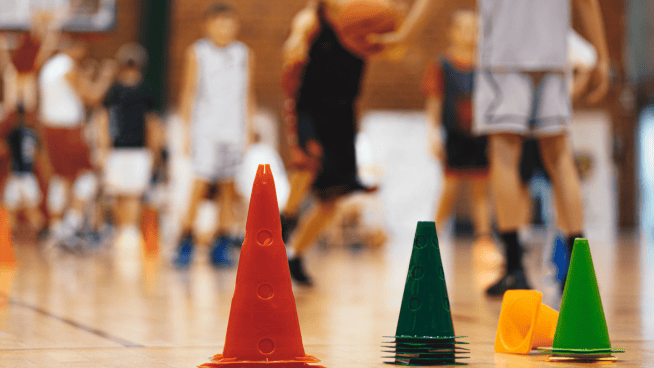
Photo: mnsoccerhub.com
Grant Geib is currently a strength and conditioning coaching assistant at the University of Tennessee. Previously, he worked as a performance coach at the Parisi Speed School. In 2009, he earned a bachelor’s degree in physical education from Ohio Wesleyan, where played football and received the Wally Cross Award for athletic and academic excellence. He graduated from the University of Tennessee with a master’s degree in kinesiology in 2011.