
Get More Out of Your Basketball Strength Training
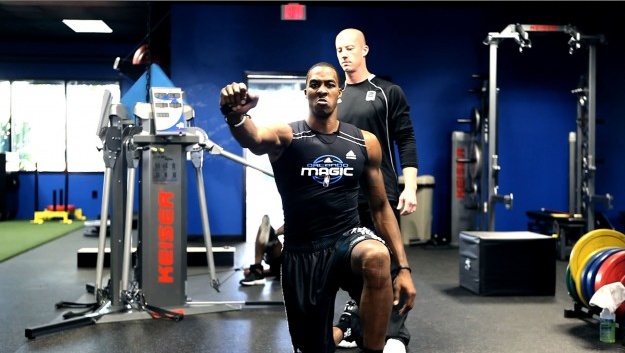
Become a better basketball player this off-season by maximizing your time in the weight room. Get more out of your off-season basketball workouts with the following five tips:
1. Focus Your Effort
Before you start training, analyze your game to identify weaknesses. You can maximize your training by focusing on turning those weaknesses into strengths.
How To
- Swallow your pride and learn to analyze your game like a scout
- Eliminate distractions
- Remember that anything less than maximum effort in the weight room is wasted time
2. Don’t Work Out Like a Bodybuilder
You’re not a bodybuilder. Don’t train like one. Learn the difference between bodybuilding and basketball training, and avoid the temptation to sculpt your beach muscles.
Bodybuilder Training
- Trains individual muscle groups
- Focuses on gaining muscle size and strength
- Workouts are slow with long rest times
- Workouts do not improve mobility and flexibility
Basketball Training
- Focuses on movement
- Workouts improve mobility and flexibility
- Trains to increase power, not strength
- Directly improves on-court performance
- Focuses on mastery of exercise technique and skills
How To
- Use exercises that keep your feet in contact with the ground or an unstable surface
- Perform exercises that involve multiple joints and muscle groups, and use isolation exercises only to supplement your training
- Perform a dynamic warm-up and cool-down, and incorporate mobility and flexibility techniques, like foam rolling
- Focus on perfect form over heavy weights
- Perform injury prevention exercises, such as Lateral Ankle Band Shuffle or Shoulder Y,T,W,L
3. Train Movements Not Muscles
Train movement patterns required for the game of basketball, like jumping and changing direction. Science tells us that isolation muscle training does not necessarily transfer to sport performance, because our brains learn movements, not muscle contractions. Babies don’t train each muscle before learning to walk. They master the movement!
Muscle Training
- Focuses on isolation exercises like Curls, Tricep Extensions, Leg Curls, Leg Extensions and Calf Raises
- These exercises are not athletic since sports skills rarely, if ever, require only one muscle group
- Individual muscle training can lead to bulky muscles and decreased mobility
Movement Training
- The exercises look and feel athletic
- Prevents injuries by improving coordination and strengthening supporting muscles
- Improves balance and body control
- Improves essential athletic movements, like the squat, lunge, hip hinge, shuffle, hip bound, jump and runs.
How To
- Perform exercises that involve moving through a full range of motion
- Add single-leg and single-arm exercises to your program
- Master technique for enhanced coordination
- Perform injury prevention exercises for the ankle, knee and shoulder.
4. Master the Basics
Little or no experience in the weight room? There’s no sense attempting advanced exercises when you lack the strength and coordination to correctly perform the basics. Know your limits and start at the beginning.
How To
- Master bodyweight exercises before adding weight or resistance
- Focus on Squats, Lunges, Planks, Push-Ups and Pull-Ups
- If you cannot control a movement, decrease the weight or resistance
- If you feel pain, stop immediately
- Start by mastering lower-body exercises you can perform at home
5. Plan
An unorganized workout wastes your time and delivers subpar results. Before you get to the gym, organize your exercises and plan your time to make sure you’re able to meet your goals.
How To
- Write down your workout
- Start with compound exercises like Squats, Deadlifts and Bench Presses
- Perform isolation exercises after compound exercises if desired
- Perform injury prevention and core exercises toward the end of your workout
- Track your sets, reps and weights
- Note anything unusual like sickness or dehydration
- Plan proper pre- and post-workout nutrition
RECOMMENDED FOR YOU


MOST POPULAR





Get More Out of Your Basketball Strength Training
Become a better basketball player this off-season by maximizing your time in the weight room. Get more out of your off-season basketball workouts with the following five tips:
1. Focus Your Effort
Before you start training, analyze your game to identify weaknesses. You can maximize your training by focusing on turning those weaknesses into strengths.
How To
- Swallow your pride and learn to analyze your game like a scout
- Eliminate distractions
- Remember that anything less than maximum effort in the weight room is wasted time
2. Don’t Work Out Like a Bodybuilder
You’re not a bodybuilder. Don’t train like one. Learn the difference between bodybuilding and basketball training, and avoid the temptation to sculpt your beach muscles.
Bodybuilder Training
- Trains individual muscle groups
- Focuses on gaining muscle size and strength
- Workouts are slow with long rest times
- Workouts do not improve mobility and flexibility
Basketball Training
- Focuses on movement
- Workouts improve mobility and flexibility
- Trains to increase power, not strength
- Directly improves on-court performance
- Focuses on mastery of exercise technique and skills
How To
- Use exercises that keep your feet in contact with the ground or an unstable surface
- Perform exercises that involve multiple joints and muscle groups, and use isolation exercises only to supplement your training
- Perform a dynamic warm-up and cool-down, and incorporate mobility and flexibility techniques, like foam rolling
- Focus on perfect form over heavy weights
- Perform injury prevention exercises, such as Lateral Ankle Band Shuffle or Shoulder Y,T,W,L
3. Train Movements Not Muscles
Train movement patterns required for the game of basketball, like jumping and changing direction. Science tells us that isolation muscle training does not necessarily transfer to sport performance, because our brains learn movements, not muscle contractions. Babies don’t train each muscle before learning to walk. They master the movement!
Muscle Training
- Focuses on isolation exercises like Curls, Tricep Extensions, Leg Curls, Leg Extensions and Calf Raises
- These exercises are not athletic since sports skills rarely, if ever, require only one muscle group
- Individual muscle training can lead to bulky muscles and decreased mobility
Movement Training
- The exercises look and feel athletic
- Prevents injuries by improving coordination and strengthening supporting muscles
- Improves balance and body control
- Improves essential athletic movements, like the squat, lunge, hip hinge, shuffle, hip bound, jump and runs.
How To
- Perform exercises that involve moving through a full range of motion
- Add single-leg and single-arm exercises to your program
- Master technique for enhanced coordination
- Perform injury prevention exercises for the ankle, knee and shoulder.
4. Master the Basics
Little or no experience in the weight room? There’s no sense attempting advanced exercises when you lack the strength and coordination to correctly perform the basics. Know your limits and start at the beginning.
How To
- Master bodyweight exercises before adding weight or resistance
- Focus on Squats, Lunges, Planks, Push-Ups and Pull-Ups
- If you cannot control a movement, decrease the weight or resistance
- If you feel pain, stop immediately
- Start by mastering lower-body exercises you can perform at home
5. Plan
An unorganized workout wastes your time and delivers subpar results. Before you get to the gym, organize your exercises and plan your time to make sure you’re able to meet your goals.
How To
- Write down your workout
- Start with compound exercises like Squats, Deadlifts and Bench Presses
- Perform isolation exercises after compound exercises if desired
- Perform injury prevention and core exercises toward the end of your workout
- Track your sets, reps and weights
- Note anything unusual like sickness or dehydration
- Plan proper pre- and post-workout nutrition