
Can You Pass This 30-Second Core Strength Test?
Athletes need a strong core. A strong core increases your power in your sport-specific skills, helps fight off injury and allows you to safely lift more weight in the gym.
But how can you tell if you actually have a strong core?
No, Sit-Ups are not the answer. Even holding a Plank for as long as you can is more a test of core endurance rather than a true measure core strength.
Instead, the answer is Loaded Carries.
Loaded Carries, such as Farmer’s Walks or Suitcase Carries, have becomes incredibly popular because they challenge core strength, hip stability, shoulder stability and grip strength—all things athletes need to get stronger and perform better.
“It all comes down to the pillar (a term that refers to the entire core, not just the abs). The best thing we can possibly do for the pillar is develop what’s called dynamic stability,” says Dr. John Rusin, physical therapist, strength coach and owner of John Rusin Fitness Systems. “Static stability is just an isometric position. Dynamic stability has a motor control component to it because you have to grade your stability and do it reciprocally as your legs go.”
In short, Loaded Carries train your core to maintain stability when you’re sprinting, jumping, changing directions, throwing a ball or tackling an opponent.
Better yet, Loaded Carries are probably the single easiest type of exercise to perform. You just need to pick a weight up and walk—OK, there’s slightly more to it, but we’ll go over that later in the article.
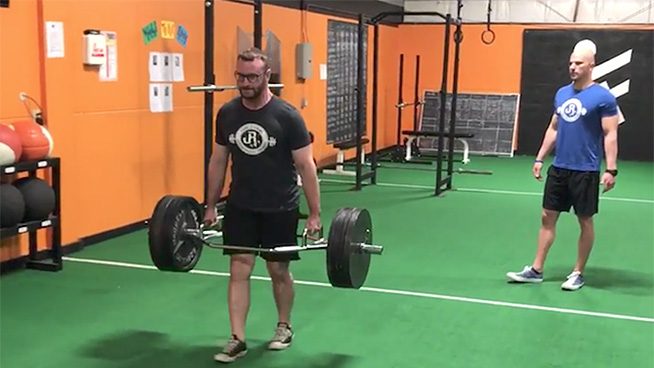
Problem is…there’s no way to tell if you’re legitimately strong in this exercise. You can compare yourself to your teammates, but have no way to know if you have elite core strength.
“People either load it to the point where they butcher it and run with the weight for like 8 seconds. Or you see people who carry something around for a couple of minutes at a time,” Rusin explains. “Nobody has ever quantified what’s really good enough.”
The happy medium between excessively heavy and endurance Carries was 30 seconds. He tested his clients to see how much they could carry for 30 seconds and correlated it with three levels of core strength. The results were published in the August 2017 edition of NSCA Coach.
Here are the three levels:
Rehabbing From an Injury – You should be able to carry 50% of your body weight for 30 seconds. This will typically be done with dumbbells.
General Fitness – You should be able to carry a weight equivalent to your body weight for 30 seconds. You can use dumbbells or a trap bar loaded with weight if you don’t have heavy enough dumbbells.
Elite – You should be able to carry twice your body weight for 30 seconds. You will need to use a trap bar loaded with weight for this test.
Some of you may scoff at carrying twice your body weight, but Rusin explains the elite athletes he works with have no problem crushing this core strength test—that’s why they’re elite. Yes, it might be humbling for some of you but that just means you have something to work toward.
So how can you get to an elite level? First and foremost, you need to know how to do a Loaded Carry the right way.
[youtube video=”_TgsiSMb32w” /]- Before you even start a Carry, you need to know how to pick up the weight. If you’re using heavy dumbbells, it’s helpful to elevate the dumbbells on boxes or benches so you don’t have to reach down as far. Keep your back flat, abs tight and use your hips as if doing a Deadlift. When using a trap bar, simply use correct Trap Bar Deadlift technique.
- Once you pick up the weight, it’s time to get into the proper position. Pull your shoulders down and back, tighten your core as much as you can and squeeze the heck out of the dumbbell or trap bar handles. The goal is to create as much tension in your body as possible.
- Now walk slowly, maintaining tension. Your core should remain locked down with each step. If you feel your movement getting sloppy, your shoulders falling forward or grip failing, then carefully set down the weights. And make sure you don’t drop heavy dumbbells on your feet.
Rusin’s solution for getting stronger in Loaded Carries is quite simple:
- Do Loaded Carries and gradually add weight to it like you would for the Bench Press, Squat, Deadlift or any other move. Just make sure you can complete the 30-second walk with control.
- Get stronger in the other primary lifts, like Squats, Deadlifts, Bench Press, Rows and Lunges. Adding strength in these moves will translate to a stronger Loaded Carry.
So where do you STACK Up? Do you have elite core strength or have some work to do? Let us know on Twitter.
READ MORE:
RECOMMENDED FOR YOU



MOST POPULAR






Can You Pass This 30-Second Core Strength Test?
Athletes need a strong core. A strong core increases your power in your sport-specific skills, helps fight off injury and allows you to safely lift more weight in the gym.
But how can you tell if you actually have a strong core?
No, Sit-Ups are not the answer. Even holding a Plank for as long as you can is more a test of core endurance rather than a true measure core strength.
Instead, the answer is Loaded Carries.
Loaded Carries, such as Farmer’s Walks or Suitcase Carries, have becomes incredibly popular because they challenge core strength, hip stability, shoulder stability and grip strength—all things athletes need to get stronger and perform better.
“It all comes down to the pillar (a term that refers to the entire core, not just the abs). The best thing we can possibly do for the pillar is develop what’s called dynamic stability,” says Dr. John Rusin, physical therapist, strength coach and owner of John Rusin Fitness Systems. “Static stability is just an isometric position. Dynamic stability has a motor control component to it because you have to grade your stability and do it reciprocally as your legs go.”
In short, Loaded Carries train your core to maintain stability when you’re sprinting, jumping, changing directions, throwing a ball or tackling an opponent.
Better yet, Loaded Carries are probably the single easiest type of exercise to perform. You just need to pick a weight up and walk—OK, there’s slightly more to it, but we’ll go over that later in the article.
Problem is…there’s no way to tell if you’re legitimately strong in this exercise. You can compare yourself to your teammates, but have no way to know if you have elite core strength.
“People either load it to the point where they butcher it and run with the weight for like 8 seconds. Or you see people who carry something around for a couple of minutes at a time,” Rusin explains. “Nobody has ever quantified what’s really good enough.”
The happy medium between excessively heavy and endurance Carries was 30 seconds. He tested his clients to see how much they could carry for 30 seconds and correlated it with three levels of core strength. The results were published in the August 2017 edition of NSCA Coach.
Here are the three levels:
Rehabbing From an Injury – You should be able to carry 50% of your body weight for 30 seconds. This will typically be done with dumbbells.
General Fitness – You should be able to carry a weight equivalent to your body weight for 30 seconds. You can use dumbbells or a trap bar loaded with weight if you don’t have heavy enough dumbbells.
Elite – You should be able to carry twice your body weight for 30 seconds. You will need to use a trap bar loaded with weight for this test.
Some of you may scoff at carrying twice your body weight, but Rusin explains the elite athletes he works with have no problem crushing this core strength test—that’s why they’re elite. Yes, it might be humbling for some of you but that just means you have something to work toward.
So how can you get to an elite level? First and foremost, you need to know how to do a Loaded Carry the right way.
[youtube video=”_TgsiSMb32w” /]- Before you even start a Carry, you need to know how to pick up the weight. If you’re using heavy dumbbells, it’s helpful to elevate the dumbbells on boxes or benches so you don’t have to reach down as far. Keep your back flat, abs tight and use your hips as if doing a Deadlift. When using a trap bar, simply use correct Trap Bar Deadlift technique.
- Once you pick up the weight, it’s time to get into the proper position. Pull your shoulders down and back, tighten your core as much as you can and squeeze the heck out of the dumbbell or trap bar handles. The goal is to create as much tension in your body as possible.
- Now walk slowly, maintaining tension. Your core should remain locked down with each step. If you feel your movement getting sloppy, your shoulders falling forward or grip failing, then carefully set down the weights. And make sure you don’t drop heavy dumbbells on your feet.
Rusin’s solution for getting stronger in Loaded Carries is quite simple:
- Do Loaded Carries and gradually add weight to it like you would for the Bench Press, Squat, Deadlift or any other move. Just make sure you can complete the 30-second walk with control.
- Get stronger in the other primary lifts, like Squats, Deadlifts, Bench Press, Rows and Lunges. Adding strength in these moves will translate to a stronger Loaded Carry.
So where do you STACK Up? Do you have elite core strength or have some work to do? Let us know on Twitter.
READ MORE: