
Build Your Swimming Power and Endurance with the Roman Ropes Workout
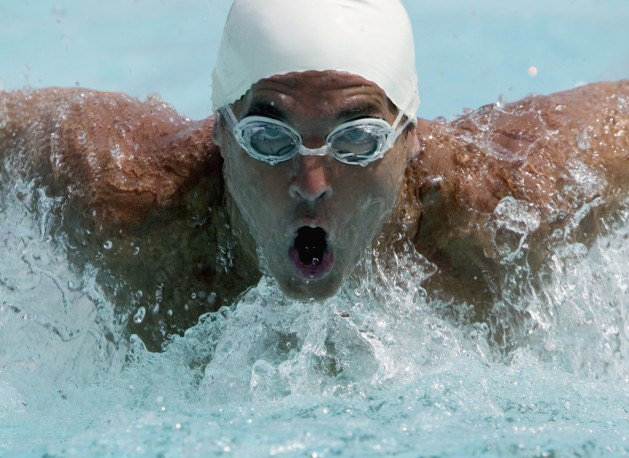
Swimmers must have extreme upper-body power and endurance to propel themselves through the water. They rely heavily on their latissimus dorsi—commonly referred to as the lats—to extend and adduct their upper arms during the swimming stroke, creating the primary driving force in the water (3, 4, 5, 6). These muscles are commonly developed with Lat Pulldowns, Pull-Ups or Bent-Arm Pullovers; however, there is a better way. (Watch U.S. Olympian Nathan Adrian train in the pool.)
Swimmers need to generate power from the lats while also flutter-kicking and keeping their torso firm (3, 4). Training the body in a way that mimics this movement pattern can be difficult in the weight room, especially for the butterfly stroke, which involves the entire body (6). Traditional weight-training exercises are commonly performed upright, or in a locked position on the floor. This is not optimal for swimmers because the swimming strokes use many muscle groups simultaneously in a rhythmic and coordinated fashion (3, 4, 6).
The solution to improving the efficacy of a weightroom swimming workout is to perform heavy rope exercises on a Roman chair. (Check out this USA Swimming ab routine.)
For those of you who are not familiar, heavy ropes (a.k.a. battle ropes) are about 1.5 to two inches in diameter, and anywhere from 25 to 100 feet long. They are swung in an undulating fashion to repeatedly make up-and-down, side-to-side or any creative wave pattern. The continuous muscle tension challenges your strength and endurance.
Battle rope exercises are typically performed standing up, but swimmers should try doing them with a Roman chair. This allows a swimmer to hold a supine position (i.e., facing the ground with a straight body) while simultaneously engaging every active swimming muscle. The waves of the rope challenge the swimming stroke muscles, and swimmers can generate power from the hips in a dolphin kick motion. The core must stabilize and the entire body must work together to help swing the ropes. The harder you swing, the more difficult the exercise becomes.
If swimmers want to get faster in the pool, they must do these exercises. Perform the “Roman Ropes” workout two to three times per week for best results.
Roman Ropes Workout
Exercises
- Slam – This is a wave-like motion of the body and arms with power coming from the glutes. Start down and move your body and arms upward and downward quickly in one powerful motion to slam the rope on the ground.

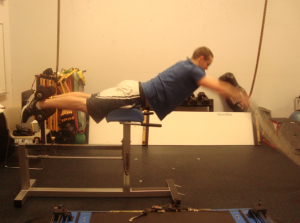
- Dual Wave – This move involves keeping the body straight with the head down and the arms out straight. Make alternating waves by moving your arms in an alternating pattern.

- Rotating Slam – This movement is similar to the slam where the body moves in a wave-like motion; however, on the way up the arms start in and go up and out in large circles.

- Horizontal Wave – This move is similar to the dual wave because the body is straight with arms out in front and head down; however, the arms move laterally making alternating flat waves.
Note: It is ideal to complete the movements in this order to avoid low-back fatigue.
Workout #1 – Power
- Slam – 2×10 seconds with 30 seconds rest
- 1 minute rest
- Dual Wave – 2×10 seconds with 30 seconds rest
- 1 min rest
- Rotating Slam – 2×10 seconds with 30 seconds rest
- 1 min rest
- Horizontal Wave – 2×10 seconds with 30 seconds rest
Workout #2 – Muscular Endurance
Repeat two times
- Slam – 20 seconds
- 10 seconds rest
- Dual Wave – 20 seconds
- 10 seconds rest
- Rotating Slam – 20 seconds
- 10 seconds rest
- Horizontal Wave – 20 seconds maximal
- 10 seconds rest
Check out the video below to learn how to perform the exercises.
[youtube video=”0PQ53jEBvXA” /]Sources
1) Champagne, A, Descarreaux, M, and Lafond, D. “Back and hip extensor muscle fatigue in healthy subjects: task-dependency effect of two variants of the Sorensen test.” Eur Spine J 17: 1721-1726, 2008.
2) Clark, BC, Manini, TM, Mayer, JM, Ploutz-Snyder, LL, and Graves, JE. “Electromyographic Activity of the Lumbar and Hip Extensors During Dynamic Trunk Extension Exercise.” Arch Phys Med Rehabil 83:1547-1552, 2002.
3) Clarys, JP, Rouard, AH. “The frontcrawl downsweep: Shoulder protection and/or performance inhibition.” J Sport Med Phys Fit 36: 121-126, 1996.
4) Ikuta, Y, Matsuda, Y, Yamada, Y, Kida, N, Oda, S, and Moritani, T. “Relationship between decreased swimming velocity and muscle activity during 200-m front crawl.” Eur J Appl Physiol 112: 3417-3429, 2012.
5) Nuber, GW, Jobe, FW, Perry, J, Moynes, DR, and Antonelli, D. “Fine wire electromyography analysis of muscles of the shoulder during swimming.” Am J Sport Med 14: 7-11, 1986.
6) Vitti, M, and Dalla Pria Bankoff, A. “Simultaneous EMG of Latissimus Dorsi and Sternocostal Portion of Pectoralis Major Muscles During Butterfly Natatory Stroke.” Electromyo Clin Neur. 24: 117-120, 1984.
RECOMMENDED FOR YOU



MOST POPULAR






Build Your Swimming Power and Endurance with the Roman Ropes Workout
Swimmers must have extreme upper-body power and endurance to propel themselves through the water. They rely heavily on their latissimus dorsi—commonly referred to as the lats—to extend and adduct their upper arms during the swimming stroke, creating the primary driving force in the water (3, 4, 5, 6). These muscles are commonly developed with Lat Pulldowns, Pull-Ups or Bent-Arm Pullovers; however, there is a better way. (Watch U.S. Olympian Nathan Adrian train in the pool.)
Swimmers need to generate power from the lats while also flutter-kicking and keeping their torso firm (3, 4). Training the body in a way that mimics this movement pattern can be difficult in the weight room, especially for the butterfly stroke, which involves the entire body (6). Traditional weight-training exercises are commonly performed upright, or in a locked position on the floor. This is not optimal for swimmers because the swimming strokes use many muscle groups simultaneously in a rhythmic and coordinated fashion (3, 4, 6).
The solution to improving the efficacy of a weightroom swimming workout is to perform heavy rope exercises on a Roman chair. (Check out this USA Swimming ab routine.)
For those of you who are not familiar, heavy ropes (a.k.a. battle ropes) are about 1.5 to two inches in diameter, and anywhere from 25 to 100 feet long. They are swung in an undulating fashion to repeatedly make up-and-down, side-to-side or any creative wave pattern. The continuous muscle tension challenges your strength and endurance.
Battle rope exercises are typically performed standing up, but swimmers should try doing them with a Roman chair. This allows a swimmer to hold a supine position (i.e., facing the ground with a straight body) while simultaneously engaging every active swimming muscle. The waves of the rope challenge the swimming stroke muscles, and swimmers can generate power from the hips in a dolphin kick motion. The core must stabilize and the entire body must work together to help swing the ropes. The harder you swing, the more difficult the exercise becomes.
If swimmers want to get faster in the pool, they must do these exercises. Perform the “Roman Ropes” workout two to three times per week for best results.
Roman Ropes Workout
Exercises
- Slam – This is a wave-like motion of the body and arms with power coming from the glutes. Start down and move your body and arms upward and downward quickly in one powerful motion to slam the rope on the ground.
- Dual Wave – This move involves keeping the body straight with the head down and the arms out straight. Make alternating waves by moving your arms in an alternating pattern.
- Rotating Slam – This movement is similar to the slam where the body moves in a wave-like motion; however, on the way up the arms start in and go up and out in large circles.
- Horizontal Wave – This move is similar to the dual wave because the body is straight with arms out in front and head down; however, the arms move laterally making alternating flat waves.
Note: It is ideal to complete the movements in this order to avoid low-back fatigue.
Workout #1 – Power
- Slam – 2×10 seconds with 30 seconds rest
- 1 minute rest
- Dual Wave – 2×10 seconds with 30 seconds rest
- 1 min rest
- Rotating Slam – 2×10 seconds with 30 seconds rest
- 1 min rest
- Horizontal Wave – 2×10 seconds with 30 seconds rest
Workout #2 – Muscular Endurance
Repeat two times
- Slam – 20 seconds
- 10 seconds rest
- Dual Wave – 20 seconds
- 10 seconds rest
- Rotating Slam – 20 seconds
- 10 seconds rest
- Horizontal Wave – 20 seconds maximal
- 10 seconds rest
Check out the video below to learn how to perform the exercises.
[youtube video=”0PQ53jEBvXA” /]Sources
1) Champagne, A, Descarreaux, M, and Lafond, D. “Back and hip extensor muscle fatigue in healthy subjects: task-dependency effect of two variants of the Sorensen test.” Eur Spine J 17: 1721-1726, 2008.
2) Clark, BC, Manini, TM, Mayer, JM, Ploutz-Snyder, LL, and Graves, JE. “Electromyographic Activity of the Lumbar and Hip Extensors During Dynamic Trunk Extension Exercise.” Arch Phys Med Rehabil 83:1547-1552, 2002.
3) Clarys, JP, Rouard, AH. “The frontcrawl downsweep: Shoulder protection and/or performance inhibition.” J Sport Med Phys Fit 36: 121-126, 1996.
4) Ikuta, Y, Matsuda, Y, Yamada, Y, Kida, N, Oda, S, and Moritani, T. “Relationship between decreased swimming velocity and muscle activity during 200-m front crawl.” Eur J Appl Physiol 112: 3417-3429, 2012.
5) Nuber, GW, Jobe, FW, Perry, J, Moynes, DR, and Antonelli, D. “Fine wire electromyography analysis of muscles of the shoulder during swimming.” Am J Sport Med 14: 7-11, 1986.
6) Vitti, M, and Dalla Pria Bankoff, A. “Simultaneous EMG of Latissimus Dorsi and Sternocostal Portion of Pectoralis Major Muscles During Butterfly Natatory Stroke.” Electromyo Clin Neur. 24: 117-120, 1984.